

Oct 27, 2026
Adam & Eve: 700 LLM-Controlled Muscles via Fine-Tuned Decision Models
Abstract
Adam and Eve are two simulated humans with 700 muscles each, living together at the Palace of Fine Arts in San Francisco. Language models run every layer of them that a language model can run: what to do with the day, where to walk, how to keep balance, where each foot lands, and how hard each muscle pulls. Three of those models are our own: 144M-parameter fine-tunes, trained on a CPU in 4 to 11 minutes each, that copy their teachers with a correlation of 0.958 to 0.9998 on inputs they never saw. With no harness, both bodies stand through 80 N pushes and walk a few dozen steps between falls. This is an experiment, not a product. We report what works, what does not, and the numbers.
1 An experiment
Technology is moving so fast that nobody knows where simulation goes next. A year ago, a language model could hold a conversation. Today, it can plan a week, use tools and run for hours. We do not know where the line is, so we tried to find it.
The question was simple: how far down can a language model go? LifeSim's people already think with language models. They decide what to do, who to talk to and where to go. Below that, every game uses animation. A body that walks is a body that plays a recording.
We replaced the recording with a body. MS-Human-700 [1] is an open model of the human musculoskeletal system with 700 muscles, simulated in MuJoCo [2]. We put two of them in one scene, on a floor made from the real map, and gave every decision we could to a language model. We did not know if it would stand. It did.
2 The layers
We copied the layers of a body and a mind, and gave each layer that can be a language model to one (Table 1). Only the spinal cord is code: it turns “lean back a little” or “put the foot here” into 700 muscle pulls.
| Layer | In a person | Model | How often |
|---|---|---|---|
| Life | What to do with the day | Gemma 3 4B [3], fine-tuned by us with GRPO [4] on LifeSim Week | Once per activity, ~4 s |
| Motor cortex | “Walk there, brace the trunk” | Gemini 3.1 Flash-Lite | About once a second, ~1 s |
| Brainstem | Keeps you upright | LifeSim-Brainstem-0.1 (ours) | 2 questions per tick, standing |
| Step decision | Where the next foot lands | LifeSim-Step-0.3 (ours) | 2 questions per tick, walking |
| Spinal cord | Fixed wiring | Code | Every tick |
| Muscles | Contract | LifeSim-Muscle-0.1 (ours) | 700 questions per tick, per person |
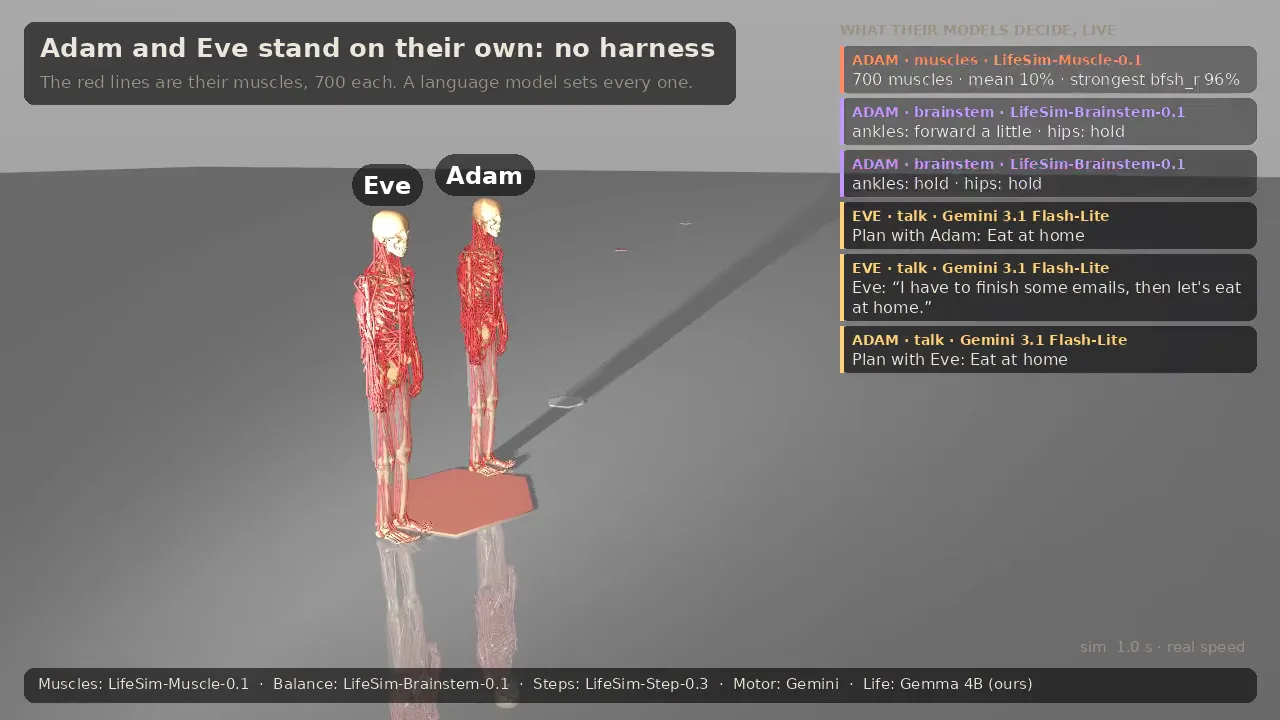
Every layer speaks in words. The brainstem reads “the weight is 3 cm in front of the middle of the feet, moving forward at 4 cm/s” and answers how to lean. Each muscle reads its body region's line from the motor cortex and an urge from the spinal cord, and answers how hard to contract.
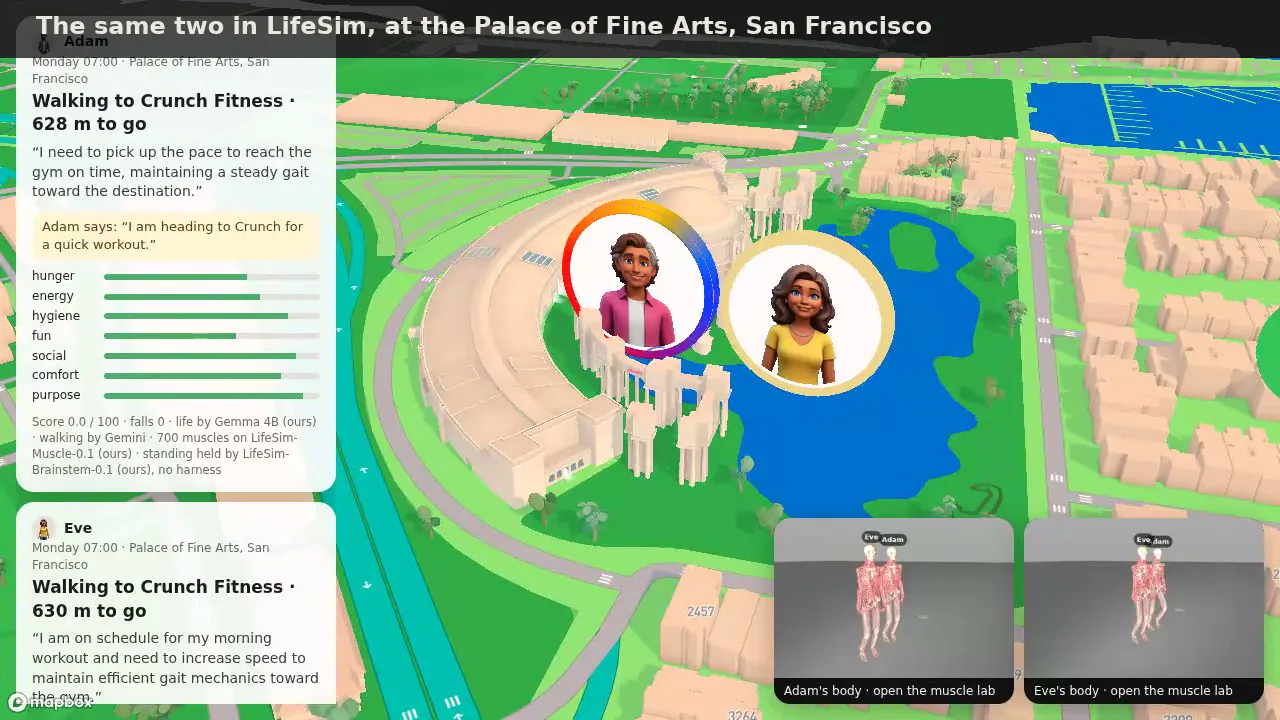
Adam and Eve also know about each other. Each life model reads where the partner is and what they are doing. When the two meet, Gemini writes one line for each of them, and they can agree on a plan: “want to grab dinner at Kibatsu later?” (Figure 3).
3 Three small models
The three lowest layers answer up to 1,400 questions every 10 ms, so they need a small model. We used Julia 1, a 144M-parameter model built on a ModernBERT [5] encoder (22 layers, hidden size 384) with a decision head, and fine-tuned three copies. Each one learned from a teacher written in code: the code brainstem, the code step rule and the muscle formula.
| Model | Training on a CPU | Base Julia 1 | Fine-tuned |
|---|---|---|---|
| LifeSim-Brainstem-0.1 | 216 s | r = −0.37 | r = 0.9997 |
| LifeSim-Step-0.3 | 308 s | r = 0.24 | r = 0.9998 |
| LifeSim-Muscle-0.1 | 642 s | r = 0.12 | r = 0.958 |
A high correlation on held-out inputs is not enough for walking. The step model first learned only from situations the code rule met, and once in control it led the body into situations the rule never saw. We let it walk, recorded what it met, asked the rule what it would have done, and trained again (DAgger [6]). Walk time rose from 83% to 92% of the teacher's.
The fine-tunes are deterministic, so the same question always gets the same answer. We keep every answer and only ask the model questions it has not seen. After a few seconds, most ticks need no model call at all.
4 Results
4.1 Standing
With every layer on a language model, both bodies stand with no harness and recover from 80 N pushes from the front and from behind. Over 20 pushed stands, the brainstem model stands as long as its teacher: 12.4 s against 12.0 s.
4.2 Walking
The walker is SIMBICON [7] on muscles: a step timer, a swing leg, and foot placement from the weight's position and speed. With no harness, the bodies walk at about 0.25 m/s, steering toward the goal. In the live simulation, the median walk lasted 18 steps between falls, and the longest 133 (Figure 2).
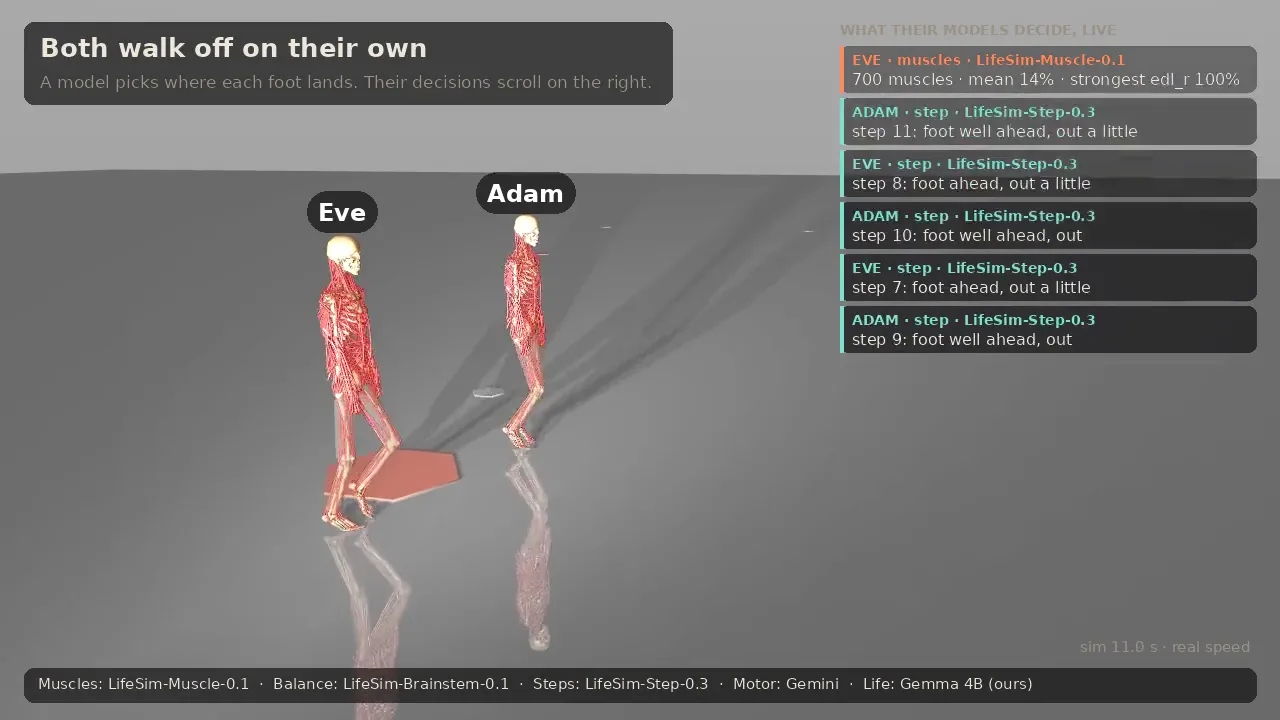
In a 12 s walk, the step model keeps the body up for 8.6 s on average, against 9.4 s for the code rule that taught it (24 walks). Standing forgives small errors. Walking does not.
4.3 Speed
Everything runs on one CPU machine, with no GPU. The simulation waits for the models (“slow time”), because balance needs a decision every 10 ms. Both bodies with every model run at 0.25 to 0.5× real time, and at 0.12 to 0.18× while both are drawn.
4.4 In LifeSim
The same two people appear on the LifeSim map, with their needs, their plans and what they say to each other (Figure 3).
5 What we learned
- Words must carry numbers. “Leaning a little forward” is too vague to balance on: the body fell in 3 to 6 s. “The weight is 3 cm in front of the middle of the feet, moving forward at 4 cm/s” keeps it up.
- The brain's words set the muscles' resolution. Under “stand still”, the muscle model answers in steps of about 15%. Under “hold steady with fine control”, the steps are about 10%, and only then does the body survive a push from the front.
- Muscles work like motor neurons. The muscle model answers in coarse steps. Alternating between neighbouring steps from tick to tick, like a firing rate, makes walks last about 50% longer.
- Walking is chaotic. Changing one gain by one part in a million changes how long a walk lasts by a third. One run proves nothing, so every walking number here is a mean over 12 or more walks.
6 What does not work yet
- Stopping. A walking body handed to the standing balance falls within a second: 0 of 20 tries stood. On arrival, the body blends into a standing pose. This is an animation, and we label it as one.
- Getting up. After a fall, the body blends back to standing in one second. Also an animation.
- Other speeds. Only the speed the walker was tuned at works.
- More tuning. Three search methods (evolution, CMA-ES and Augmented Random Search) could not improve the walker. A sturdier one needs a whole-body controller, or a policy trained with reinforcement learning on a GPU.
7 Why we tried this
We did not set out to build the best walker. Reinforcement learning makes better ones. We set out to see whether one kind of model can reach from “what do I do this evening” down to “which muscle pulls how hard”. It can, with help from a few lines of code in the middle. Small open models, fine-tuned on a CPU in minutes, can take most of the layers.
We do not know yet what this is for. Perhaps people in LifeSim who move because they decide to, not because an animation plays. Perhaps nothing. Technology is moving too fast to say, which is the reason to try things like this now, and to share what we find.
8 Future work
The most promising result is that words change the body: “hold steady with fine control” gave the muscles a finer resolution than “stand still”, and only then did the body survive a push from the front. The next experiment is to show the same body responding to different words, such as “walk like you're tired”, “brace for a push” or “relax”. A code controller cannot take an instruction like that. A language model can.
References
- Zuo, C., He, K., Shao, J., Sui, Y. Self Model for Embodied Intelligence: Modeling Full-Body Human Musculoskeletal System and Locomotion Control with Hierarchical Low-Dimensional Representation. ICRA, 2024.
- Todorov, E., Erez, T., Tassa, Y. MuJoCo: A physics engine for model-based control. IROS, 2012.
- Gemma Team. Gemma 3 Technical Report. arXiv:2503.19786, 2025.
- Shao, Z., Wang, P., Zhu, Q., Xu, R., Song, J., et al. DeepSeekMath: Pushing the Limits of Mathematical Reasoning in Open Language Models. arXiv:2402.03300, 2024.
- Warner, B., Chaffin, A., Clavié, B., Weller, O., Hallström, O., et al. Smarter, Better, Faster, Longer: A Modern Bidirectional Encoder for Fast, Memory Efficient, and Long Context Finetuning and Inference. arXiv:2412.13663, 2024.
- Ross, S., Gordon, G. J., Bagnell, J. A. A Reduction of Imitation Learning and Structured Prediction to No-Regret Online Learning. AISTATS, 2011.
- Yin, K., Loken, K., van de Panne, M. SIMBICON: Simple Biped Locomotion Control. ACM SIGGRAPH, 2007.
Citation
Please cite this work as:
@misc{lifesim2026adamandeve,
  title  = {Adam & Eve: 700 LLM-Controlled Muscles via Fine-Tuned Decision Models},
  author = {{Cris Lenta}},
  year   = {2026},
  month  = {oct},
  url    = {https://lifesim.com/research/adam-and-eve}
}