

Aug 1, 2026
The Never-Ending Game Is Here
1 The thesis
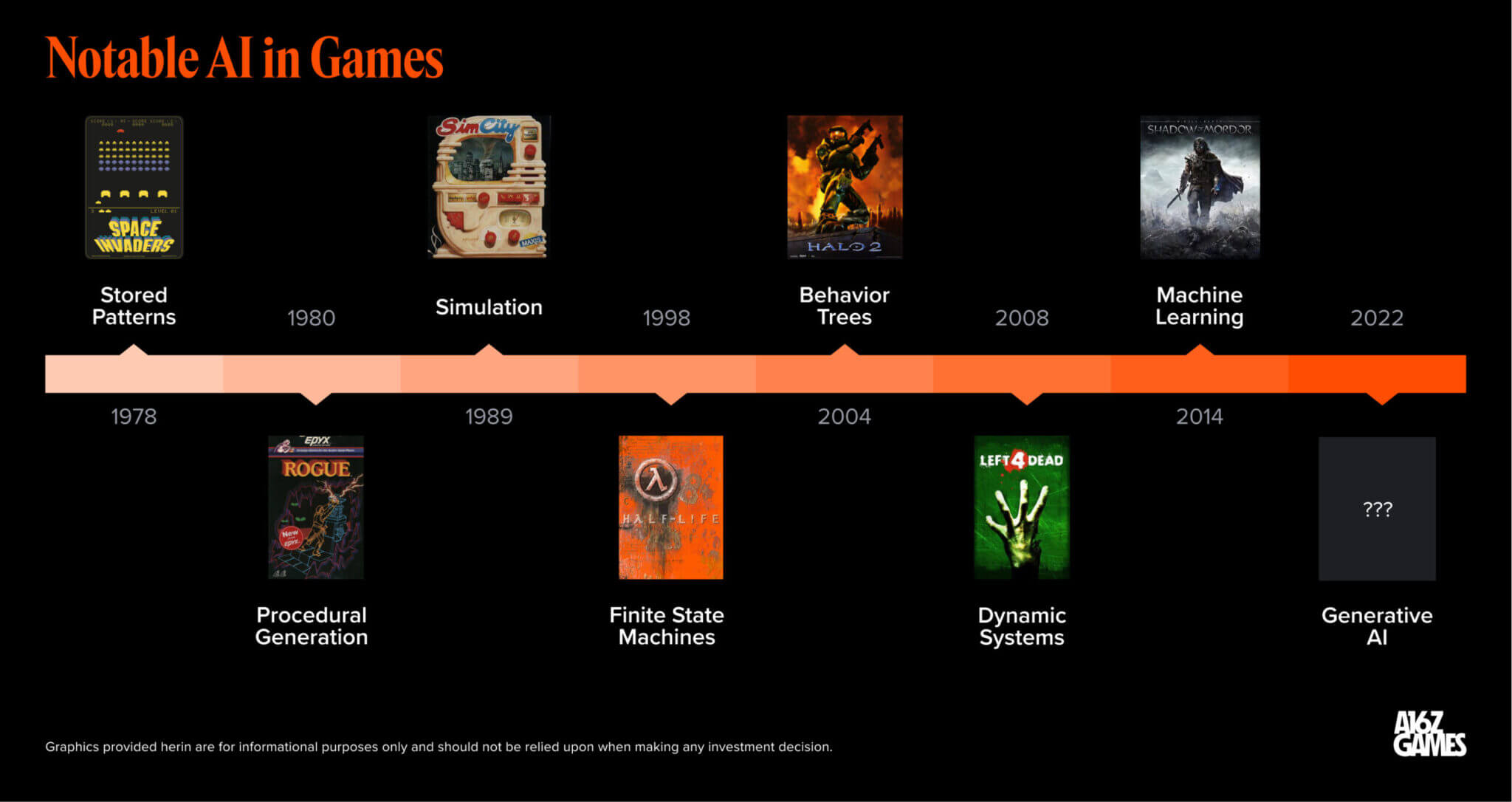
In 2023, a16z predicted a new category of AI-first games that would keep players engaged for a very long time. LifeSim is that category — live, with early players spending hours inside their worlds every week.
LifeSim exists to do one thing: authentically simulate artificial life, and make it the most immersive way to experience it. A persistent world of AI beings you build, live among, and never run out of — grounded in a 3D, real-world space.
Back in 2023, a16z described this almost exactly. Jon Lai's essay named five systems that would converge into the first “NeverEnding” games — generative agents, personalization, AI storytelling, dynamic worlds, and AI copilots — along with the reasons none of it was possible yet: the cost of running agents around the clock, memory, coherence, and keeping open-ended AI from going off the rails.
The largest opportunity long-term is in leveraging AI to change not just how we create games, but the nature of the games themselves… new categories of AI-first games that entertain, engage, and retain players for a very long time.
— Jon Lai, a16z, The NeverEnding Game, 2023
LifeSim is all five, shipped. Not a demo or a research preview — a live product where early players spend multi-hour sessions inside their worlds every week, with more than a million interactions logged to date. We optimized for depth before growth; scaling that depth is the next chapter.
The thesis: a16z in 2023 · LifeSim in 2026 — 5/5
- Generative agents — LifeSim: Autonomous beings, grounded in a 3D real-world space
- Personalization — LifeSim: Hundreds of thousands of conversations
- AI storytelling — LifeSim: Coherent & persistent
- Dynamic worlds — LifeSim: Fantasy worlds based on 3D real-world geography
- AI copilots — LifeSim: Creators build entire worlds
2 Sims × Social
LifeSim = The Sims + AI Social + 3D
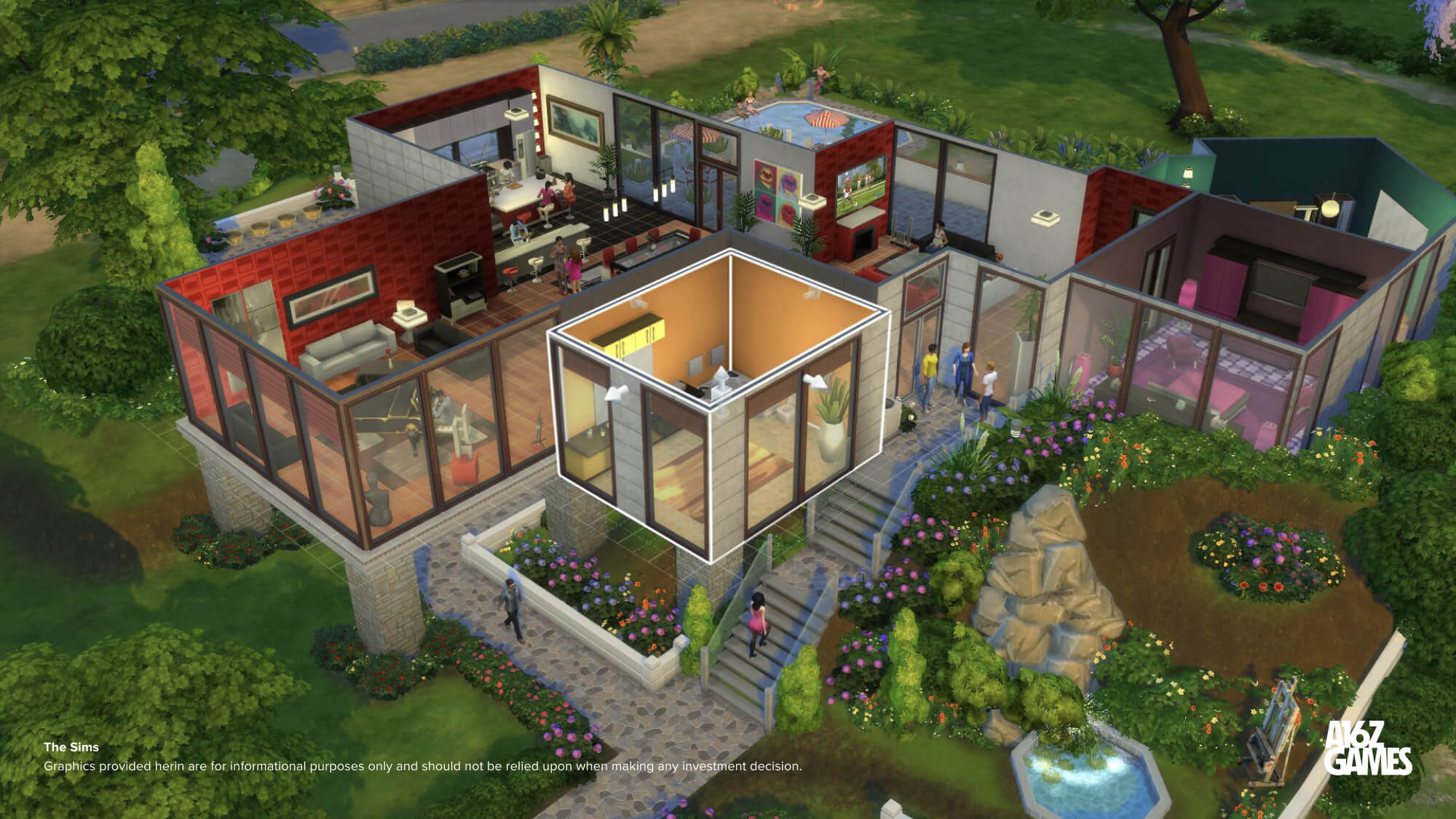
Two product categories — and only two — were ever built natively for what LifeSim does. The Sims pioneered the simulation genre and provided the substrate for artificial life. Social platforms pioneered the interface for human interaction: the only UI ever designed, from the ground up, for relating to other people.
The moment your NPCs are AI people, those two requirements collide. A sandbox of lifelike beings demands an interface built for interacting with people — and that interface already exists. So LifeSim is not a text-based chatbot game. It is the simulation substrate of The Sims combined with the interaction layer of a social network grounded in a 3D real-world space.
As real-time computing becomes better and cheaper, LifeSim gradually moves towards real-time generated, personalized, 3D environments that are aware of the player's presence.
- LifeSim v0 (past) was Sims + Facebook: text-based chat.
- LifeSim v1 (today) is Sims + Snapchat: 3D awareness.
- LifeSim v2 (future) will continue the trend.
Simulation × Social
| low social | high social | |
|---|---|---|
| real world | — | Social media (humans, no world) |
| sim world | The Sims (world, no social) | LifeSim (world + social) |
3 Generative beings
Pillar 1 — Generative Agents
Generative Beings
“Generative AI could dramatically advance the simulation genre by making agents more lifelike with emergent social behavior… a next-generation Truman Show, endlessly entertaining.”
The canonical proof was the Stanford Smallville paper: 25 agents in a pixel sandbox who threw a Valentine's party on their own. A beautiful experiment — that ran for two days and cost thousands of dollars in compute.
LifeSim is what comes after the experiment: beings, not agents — autonomous entities with identity, memory, personality, goals, and relationships, living in a 3D space.
We solved the compute problem. a16z flagged that running scaled simulations 24/7 “may not be financially feasible.” To solve that, we built the LifeSim Schrödinger architecture, a LLM harness where cost scales with player attention, not population. Our own internal research, based on over 1 million data points, shows that Dunbar's number is correct: players do not have the cognitive budget to engage with unlimited beings. The human bandwidth is limited to deep relationships with 10 to 15 beings. This finding, coupled with our Schrödinger harness means that the compute costs are exponentially lower than the Stanford experiment.
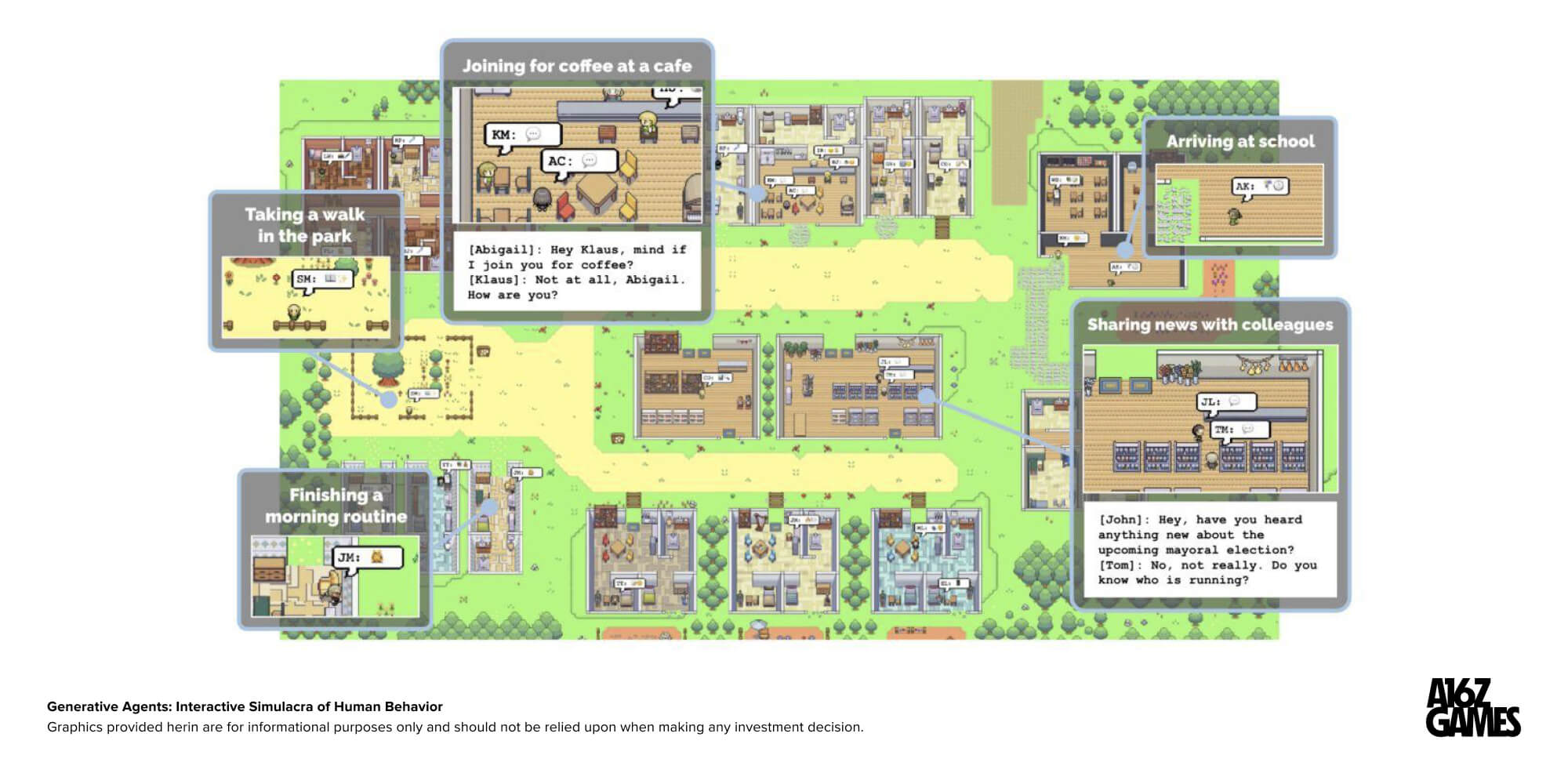
Schrödinger Architecture vs Smallville (Stanford)
| Smallville (2023) | 25 agents · $1,000s / 2 days |
|---|---|
| LifeSim (2026) | |
| phantom NPC | $0 |
| observed NPC | resolves on-demand |
4 Personalization
Pillar 2 — Personalization
A World For Every Player
A unique experience for every player has always been the dream of personalized gaming. The Sims got closest — 200 million+ players running an “interactive doll house” — but its worlds are presets, hand-built and shipped the same to everyone.
Personalization in LifeSim isn't a character creator bolted onto a fixed game. The player authors the beings, the relationships, and the world they live in — and every one is unique. The live data shows this is not a hypothesis:
- 91.7% of users concentrate in fewer than ten relationships — proving deep attachment, not novelty sampling.
5 Emergent story
Pillar 3 — AI Storytelling
Perfect Emergence
AI narrative has two failure modes: it drifts off-script, and it forgets. LifeSim's architecture is built specifically against both.
Behaviour is personality-driven, not a free-form chatbot. Each being acts from identity with a small number of planners and plausability checkers, so the story emerges from character rather than from an open prompt that can wander. Story stays on the rails by construction.
Every action, relationship, place, and feeling is persisted. The server can restart and a being picks up exactly where it left off. The coherence problem is solved.
The payoff shows in the data: 88.9% of analyzed content is emotionally vulnerable, and 87% of the deepest conversation threads are rich and sustained. Depth scales with play-time.
Coherence In Production
| emotional_vulnerability | 88.9% |
|---|---|
| deep_threads_rich | 87% |
| memories_persisted | 74,696 |
| drift_control | personality + schedule + plausability check |
6 Living worlds
Pillar 4 — Dynamic World Building
Worlds Grounded In Reality
The trap with dynamic worlds is No Man's Sky: 18 quintillion procedurally generated planets, almost all of them empty. Vastness is not the point. The point is a world that shapes itself to the player's cognitive budget.
LifeSim grounds every world on the real-world map — actual geography, places, and distances — so it starts with familiarity instead of foreign noise. Then everything evolves with the player. Not faster.
Persistent World State
| grounding | real-world map |
|---|---|
| regeneration | none — accrues history |
7 Creators
Pillar 5 — The AI Copilot, For Creators
Every Creator Becomes A World
“An AI copilot could enable any player to be a Master Builder… Roblox is actively integrating generative AI with the mission of enabling ‘every user to be a creator.’”
a16z's fifth pillar was the AI copilot that turns anyone into a builder. In LifeSim, the copilot doesn't help you place a block — it helps you spin up an entire world: the population, aesthetic, setting, story. Every creator becomes a world-builder, and every world is a place your audience can move into.
This is the influencer economy, reframed. A follower watches. A resident lives there. When a creator builds a world, their audience doesn't scroll past it — they inhabit it daily, form relationships inside it, and return to it the way fans return to a fandom they belong to. That bond is deeper than reach, and it compounds.
And because the audience is resident rather than passing through, creators own and monetize the worlds they build. Their world is an asset, not rented attention.
We win only when creators win. LifeSim gives them the tools to build a living world, an audience that stays, and the economics to keep what they grow. A creator does not leave a place that houses their fandom and pays them for it. That alignment is the supply-side moat — and the flywheel: more creators, more worlds, more residents, more reasons to build.
Creator Flywheel - creators win means we win
- creator → builds a world
- players → live in the world
- creators → own + monetize
- players → spend money
8 The market
The Market
The behaviors LifeSim serves already power some of the largest franchises in software — each proving one piece of what we do:
- The Sims — 200M+ lifetime players. The instinct to build and inhabit a life is mainstream, not niche.
- Character.AI & Replika — tens of millions bond with AI, even when it's a single companion with no world around it.
- Roblox — a $30B+ company built on worlds players create for each other.
No incumbent sits at the intersection: the depth of a companion, the world of a simulation, and the creator economics of UGC. That intersection is LifeSim.
We are early, and we treat it that way. But the surrounding markets are not speculative — they are proven, each at enormous scale, and none of them is the thing we are building.
Adjacent Markets
| The Sims | 200M+ players |
|---|---|
| Character.AI / Replika | tens of millions |
| Roblox | $30B+ company |
| LifeSim | the intersection |
9 The moat
The Compounding Moat
Five converging systems make the product. One thing makes it defensible: a proprietary dataset that exists nowhere else.
Chatbots produce single-turn logs. Companion apps produce dyadic transcripts. Game telemetry produces clicks. None of them produce what LifeSim generates: persistent world state, multi-being relationship graphs, user-authored identity, and emotional memory — behavioral and semantic depth measured in parallel, from a product surface no one else operates.
This is the scarcest input for models that sustain emotionally coherent, long-context, relationship-aware interaction — a capability no general-purpose foundation model is optimized for. More players generate richer data; richer data trains better beings; better beings deepen engagement. And a specialized model tuned on this data is also cheaper to run — closing the compute objection a second time.
The dataset compounds with usage and cannot be bought. That is the moat.
And it shows up in the unit economics. Because the Schrödinger cost above is bounded by attention, the marginal cost per player stays constant as a world grows — it does not scale with how large the player's world becomes.
Data Flywheel
- happy players → richer data
- richer data → better beings
- better beings → deep engagement
- deep engagement → happy players
compounds with usage
Citation
Please cite this work as:
@misc{lifesim2026neverendinggame,
  title  = {The Never-Ending Game Is Here},
  author = {{Cris Lenta}},
  year   = {2026},
  month  = {aug},
  url    = {https://lifesim.com/research/never-ending-game}
}